
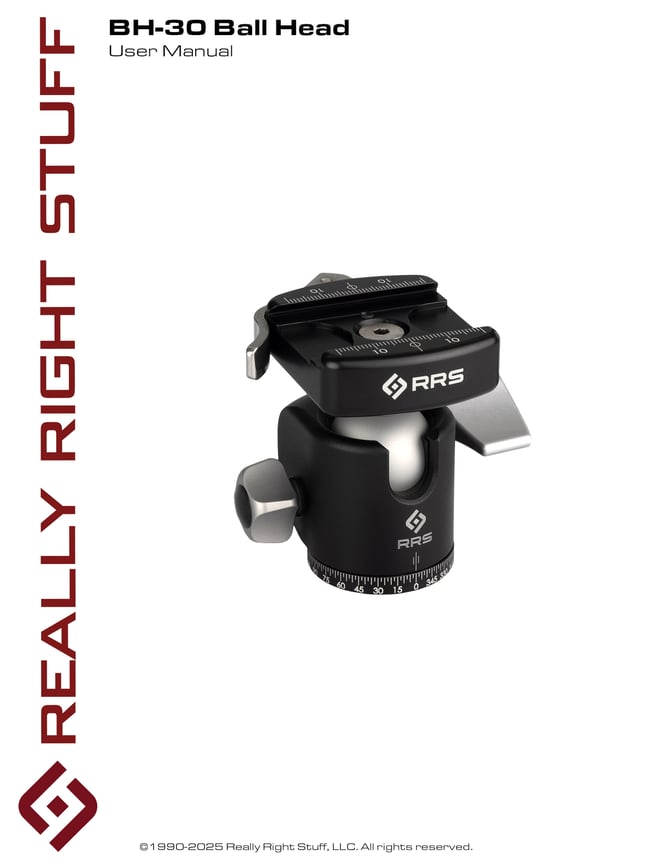
THANK YOU for choosing a Really Right Stuff BH-30 Ball head. It is the culmination of years of development based on first-hand experience and abundant input from seasoned professionals. Please review this manual to see how you can get the most from your BH-30.
SPECIFICATIONS: BH-30 LR
| Load Capacity | 15 pounds (6.8kg) |
| Ball Articulation | ±45º, 90º notch |
| Tension Adjustment | Main Lock T-lever |
| Panning Base | 2.5º increments, zero to 360º |
| Height | 2.9” (75mm) |
| Tripod Mount | Stainless Steel 3/8”-16 |
| Base Diameter | 1.6” (41mm) |
| Ball Diameter | 1.2” (30mm) |
| Weight w/ B2-40 LR Clamp | 11.4 ounces (324g) |
| Optional Platform and Stud | 1½” platform and ¼” stud |
| Main Lock T-Lever | Spring loaded & repositionable |
| Clamp Options | B2-40 LR, B2-mAS, B2 AS II, B2-Pro II, or PCL-1 |
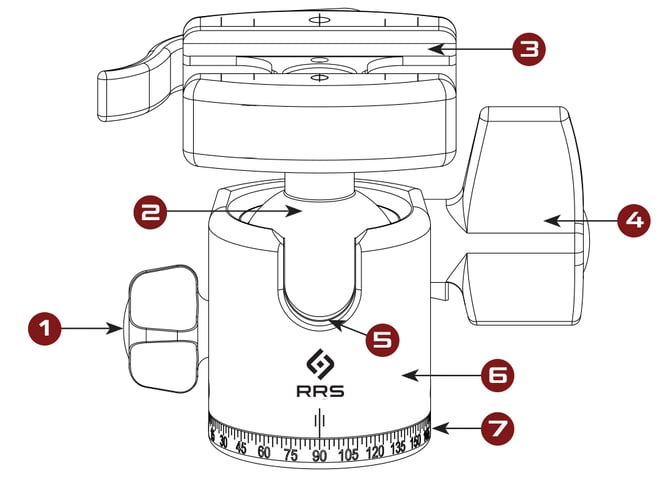
KEY FEATURES
1. Pan Lock Knob — Our exclusive drum and band panning brake locks with an ergonomic scalloped knob. Conveniently shaped with detents, you can easily apply enough force to unscrew the ball head by hand without the panning base slipping.
2. 30mm Ball — The 30mm ball is hollow for reduced weight, and its shape and finish allow for smooth and precise movement.
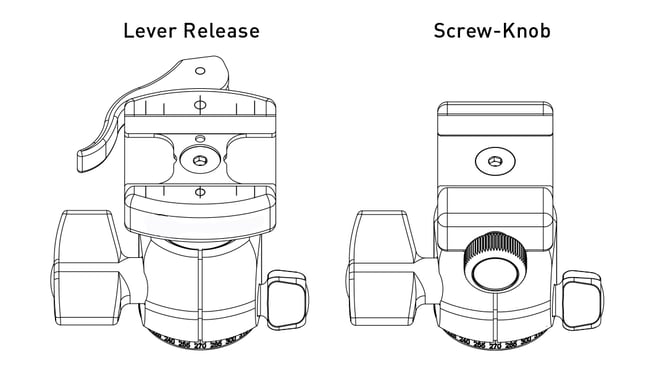
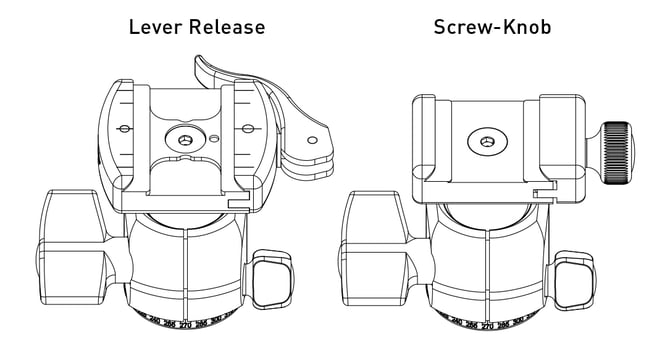
3. Quick-release Clamps — Really Right Stuff quick-release clamps feature the option of screw-knob or lever-release styles. We offer many sizes, from mini clamps to extra long clamps. Though any of our quick-release clamps can be installed onto the ball head, the B2-40 LR and B2-mAS clamps are the best choices.
4. Main Lock T-Lever — Our ergonomic T-lever is designed for easy locking of the ball. It can be pulled out and repositioned for optimal ergonomics.
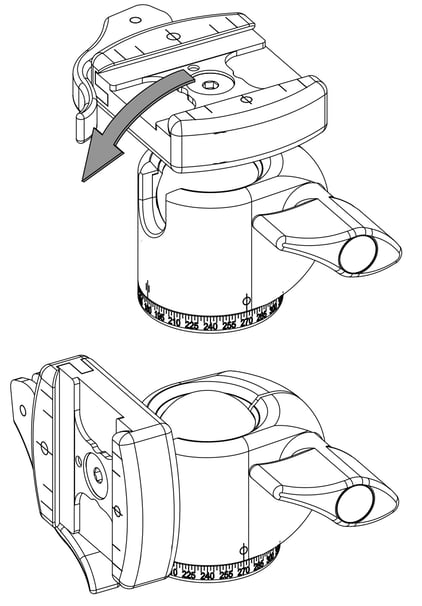
5. Drop Notch — Used in conjunction with the panning function, the drop notch is used to position your camera at angles greater than 45º. At full drop, the camera is positioned 90 degrees from top dead center of the ballhead, allowing for portrait orientation and/or gimbal style movement. Protection from accidental fallout is ensured if you use an RRS quick-release plate with safety stop.
6. Aluminum Body — The CNC machined body serves as both the structure and the clamping mechanism of the ball head. This is furnished by a unique split body design, which is robust, lightweight and sealed to prevent dust contamination. Finished with satin black anodizing, it can withstand abrasion and corrosion while looking beautiful.
7. Engraved Pan Base — The pan base features a mark every 2.5º and is labeled from 0º to 360º. Located on the main body just below the drop notch is an index mark for tracking progressive panning, used in multi-shot panoramic photography.
MAINTENANCE
General Care
The BH-30 is finished with a protective anodize plating that protects the aluminum from corrosion and mild abrasion. It will not protect it from scraping against or dropping on rocks/concrete/etc.
The BH-30 comes packed in our protective LB-40 Cordura Pouch (pouch not included when BH-30 is purchased without clamp or platform).
Keep the BH-30 in this pouch whenever practical. When transporting your tripod, cover ball head with the pouch and tighten the drawstring around the bottom to keep it in place.
Cleaning
Take whatever precautions you can to prevent your BH-30 from getting fouled in mud, dirt, or sand. A good habit is to keep a plastic bag with your camera gear to quickly cover your camera and ballhead if you get caught in a rain/sandstorm. If the BH-30 is fouled, dry dust and dirt can be blown off and/or wiped off with a soft cloth. Mud or salt water should be lightly rinsed off with fresh water and then thoroughly dried. Do NOT submerge the ballhead when washing and do not direct a high-pressure stream of water at the ballhead.
All the knobs are captive, meaning they cannot come off without damaging them so do not attempt to remove the knobs. If fine sand/grit fouls the knob, simply run a gentle stream of water around the knob while rotating it one-half turn back and forth.
Break-In
The ball head is tuned to maximize holding capacity and deliver super-fast lockup. If you like to work with a fully loose ball with no pre-set tension, the ball head is ideal for you “out of the box”. However, those who like to operate the ball head with a given amount of drag may find that articulating a pre-tensioned ball head is not as silky smooth as desired. Keep in mind, after using the head for a period of time there will be some noticeable softening of the action. Customers have been known to lubricate their ball head for increased fluidity of motion, however we do not recommend this.
Lubrication not needed
The BH-30 is lubricated at the factory and parts that require lubrication are sealed. NO LUBRICATION IS REQUIRED BY THE USER. Especially DO NOT LUBRICATE THE BALL as this will decrease the lock-up capacity and tend to attract dirt/dust. Just keep the ball free from contamination to maintain smooth action.

OPERATION
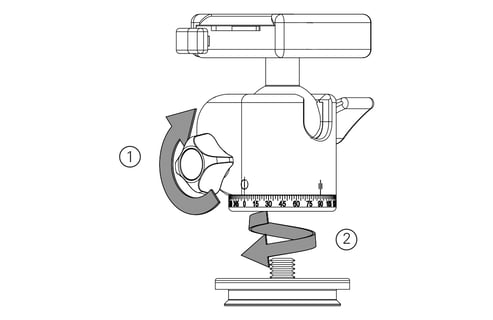
Attaching the BH-30 to your Tripod
1. Tighten the Pan Lock Knob to lock the Panning Base. NOTE: Sufficient lockup of both the pan and the ball can be achieved with light to medium torque. Over-cranking the pan lock knob may even result in unwanted drag on the ball.
2. Screw the ball head onto the 3/8”-16 threaded stud on the top of the tripod (stud should not protrude more than 3/8” above platform or 5-6 threads). Tighten the ball head onto the tripod snugly, but do not over-torque or it will be difficult to remove.
Set Up Your Tripod
Set up your tripod to match the required camera position.
Orient the Ball head
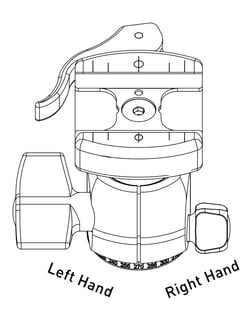
Loosen the Pan Lock Knob and rotate the body of the BH-30 ball head so that you may operate the Main Lock Knob with your left hand while your right hand is free to operate the camera controls. Tighten Pan Lock Knob to secure the orientation.
Orient the Quick-release Clamp
1. Camera Body Plates & L-Plates:
For quick-release plates with left/right dovetail orientation, orient your clamp as illustrated:
2. Lens Plates & Rails:
For quick-release plates with fore/aft or bidirectional dovetail orientation, orient your clamp as illustrated:
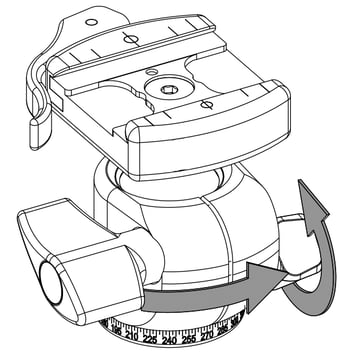
Using the Drop Notch
1. Loosen the Pan Lock Knob and rotate the body 90º counter clockwise. Retighten Pan Lock Knob.
2. Fully seat camera into the drop notch.
Tighten the Main Lock T-Lever
If using a long telephoto at slow shutter speeds, it is best to tighten the Main Lock T-Lever before exposing your shot. Use the Main Lock T-Lever to control both drag and lock.If desired, keep slight drag on the ball. Use more drag for heavy cameras and lenses and vice-versa.
As you adopt a procedure that works for you, it’s best to practice that working mode consistently until it becomes second nature. This will save you time in the field and help avoid costly mistakes. Seasoned pros are able to setup and shoot literally within seconds.